

Emotional Intelligence and Project Management Analysis

Abstract
Emotional intelligence (EI) has become a critical competency in modern project management due to its influence on communication, collaboration, and overall team effectiveness. Drawing on Bailey’s (2015) article Emotional Intelligence Predicts Job Performance, this paper examines how EI traits such as empathy, self-awareness, relationship management, and communication shape team dynamics and project outcomes. The analysis explores strategies for integrating EI into team assessments and practices, evaluates whether EI can be developed, and incorporates personal reflection on how EI influences my own project leadership approach. Two conceptual visualizations illustrate the relationship between EI traits and project outcomes. Overall, the discussion supports the position that EI is both accessible and developable, and that project managers should actively cultivate EI competencies to improve team performance.
Graphical Abstract

Introduction
The increasing complexity of organizational projects has amplified the importance of emotional intelligence (EI) as a driver of performance and collaboration. Bailey (2015) highlights seven essential EI traits including empathy, adaptability, and conflict management that distinguish effective managers and influence job performance. For project managers who are responsible for navigating uncertainty, motivating diverse teams, and resolving conflict, EI is more than a “soft skill”; it is an operational requirement. This discussion analyzes how EI informs project team management and considers whether EI should be viewed as an innate trait or a learned skill.
The seven traits that contribute to Emotional Intelligence form an interdependent structure that combines affective, cognitive, and behavioral competencies (see Figure 1).
Figure 1: Concentric Model of the Seven Traits Underpinning Emotional Intelligence (EI).

Methods
This discussion draws on an interpretive analysis of Bailey’s (2015) article alongside contemporary literature on emotional intelligence, leadership, and project management. Academic and practitioner sources were reviewed to identify recurring EI constructs and their relevance in project settings. Personal reflective practice was incorporated to contextualize the theoretical concepts within my own evolving project management experience.
Figure 2: Methods used to analyze emotional intelligence and project management concepts.

Results
Factoring Emotional Intelligence Into Team Management
Bailey (2015) argues that emotionally intelligent employees engage more effectively with others and perform better under complex conditions. As a project manager, several EI-focused strategies can be incorporated into resource planning and team leadership:
Assessing Empathy and Interpersonal Sensitivity
Team members who demonstrate empathy tend to collaborate more effectively, anticipate problems, and support inclusive decision-making. Conversely, employees who work solely for task completion without considering the impact of their behavior present communication and coordination risks (Feely, 2019).
Evaluating Relationship Management Capacity
Conflict resolution ability is central to project work, particularly when navigating tight deadlines and cross-functional stakeholders. Individuals who proactively manage conflict help stabilize team morale (Landry, 2019).
Observing Feedback Behaviors
Team members with higher EI accept constructive feedback without defensiveness and provide feedback respectfully. This trait often predicts a willingness to grow and contribute to team learning (Rudder, 2019).
Monitoring Communication Practices
Effective communication knowing what, how, and when to communicate strongly correlates with EI. Bailey (2015) emphasizes communication clarity and emotional regulation as key determinants of performance.
Recognizing Cultural Intelligence (CQ)
With global and multicultural teams becoming the norm, EI overlaps significantly with cultural intelligence. Employees who adapt well to diverse work environments generally display higher EI levels.
Figure 3: Integrated Visualization of Emotional Intelligence (EI) Foundations, Development Processes, and Project Outcomes.
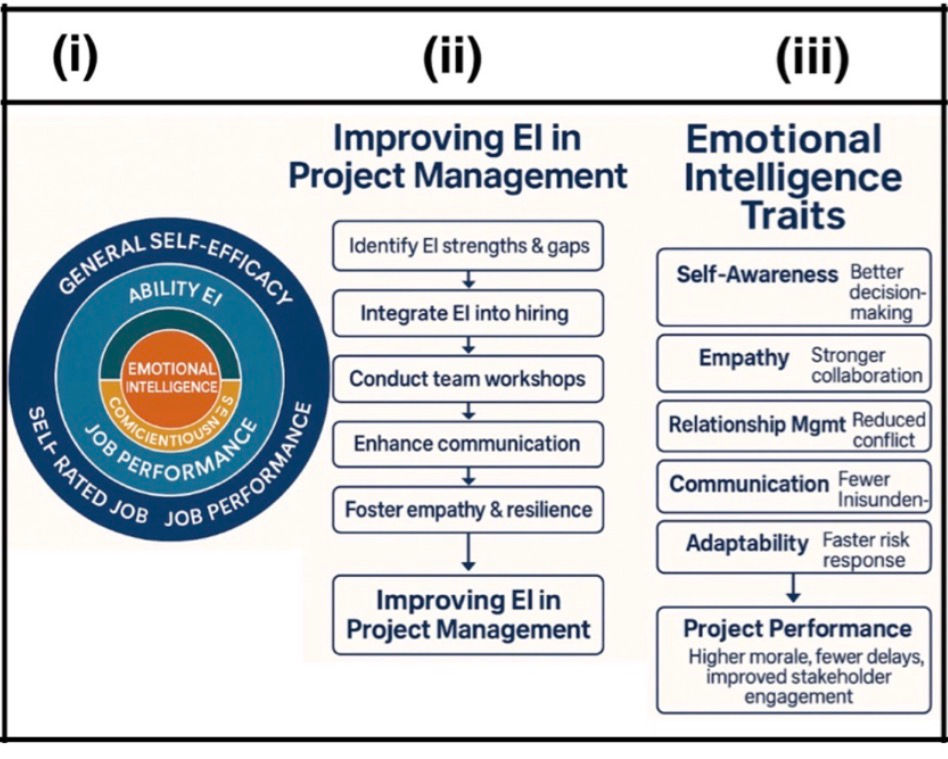
This composite figure synthesizes three interconnected perspectives on Emotional Intelligence (EI) as applied to project management. Panel (i) presents a concentric trait model illustrating the core construct of EI and its empirically linked predictors, including conscientiousness, cognitive ability, ability EI, extraversion, general self-efficacy, and self-rated job performance. Panel (ii) depicts a developmental process model outlining sequential interventions for strengthening EI within project teams, beginning with diagnostic assessment and advancing through EI-aligned hiring, targeted workshops, communication enhancement, empathy cultivation, and feedback culture improvement. Panel (iii) links specific EI competencies such as self-awareness, empathy, relationship management, communication, and adaptability to corresponding behavioral and performance improvements, culminating in heightened project performance. Together, these visualizations offer a multi-level conceptual framework demonstrating how EI influences individual attributes, team dynamics, and organizational project outcomes.
Discussion
Can Emotional Intelligence Be Developed?
The long-standing debate about whether EI is innate or learned is central to leadership literature. While early research suggested EI might be a “fixed trait,” contemporary scholarship strongly supports the idea that EI can be cultivated through deliberate training and reflective practice (Bailey, 2015; Landry, 2019).
My position aligns with this developmental perspective for three reasons:
Neuroplasticity enables emotional and behavioral adaptation.
Workplace training programs consistently show improvements in EI-related behaviors.
Individuals grow as life experiences reshape how they interpret and respond to emotions.
Even individuals who naturally exhibit high EI must continue refining it through intentional practice, coaching, and feedback.
Personal Reflection
Engaging with this topic significantly reshaped how I conceptualize leadership within project environments. Throughout my professional and academic journey, I have observed that technical expertise alone is insufficient for ensuring project success. The teams that perform best are often led by managers who understand human dynamics, not just task structures.
Reflecting on my own leadership style, I recognize that I naturally emphasize empathy and communication, especially during moments of conflict or ambiguity. However, reviewing Bailey’s (2015) work reminded me that EI is not a static strength; it requires strategic, continuous learning, and refining. For instance, I have learned that providing balanced feedback offering both support and challenge is essential for building trust. I also realized that I must further strengthen my adaptability, particularly when working with culturally diverse teams and navigating emotionally charged situations.
This reflection reinforced a key insight: emotional intelligence is a strategic asset in project management, and intentionally developing it contributes not only to professional success but also to personal growth.
Conclusion
Emotional intelligence directly influences job performance and team effectiveness. Project managers who intentionally observe, assess, and cultivate EI within their teams can mitigate conflict, strengthen communication, and enhance project outcomes. While EI may have innate components, it is fundamentally a skill that can be developed over time. As project environments grow more complex, emotionally intelligent leadership becomes not optional but essential.
References
Bailey, S. (2015). Emotional intelligence predicts job performance: The 7 traits that help managers relate. Forbes. http://www.forbes.com/sites/sebastianbailey/2015/03/05/emotional-intelligence-predicts-job-performance-the-7-traits-that-help-managers-relate/
Feely, D. (2019, August 8). 5 factors of emotional intelligence. Transforming Solutions.
Landry, L. (2019, April 3). Why emotional intelligence is important in leadership. Harvard Business School Online.
Rudder, C. (2019, April 3). 10 signs of emotionally intelligent teams. The Enterprisers Project.
Watt, A. (2014). Project management. BCcampus.


Great article with new insights and perspectives